This month’s column for The Wild Hunt is called Bastard Children of a Slaughtering Empire.
I woke into the world as an ‘American,’ not as a Shawnee, a child of Empire and Capital, descended from displaced peasants from many other lands. From my father ran blood of Alsatians, Swabians, French, Irish and Welsh; from my mother came more French and Welsh and a bit of English.
I was formed from the blood and semen of peoples without title, wealth or trades. Displaced and impoverished people crafted the homunculus of me, mewling in an aluminum trailer. I was born the bastard heir of Colonialism, suckling not at the teat of imperial wealth pumps but upon rags dipped in the vats of government charity.
I knew none of this then. Empire was a thing elsewhere, wealth the currency of cities on the other side of those low mountains.
Slaughter of peoples, when you are a child, is for the story-books and the 3 channel-reception of the small glowing screen: cowboys shooting Indians, Romans burning Heathens and Christians, Hitler marching Jews to ovens. Ancient peoples and their gods were all over-ocean and under far-flung skies, not by the low mound by which I played and napped.
Ancestors from over an ocean settled in untouched forests, unwitting footsoldiers of Imperial reach, pushing the descendents of mound-builders ever westward, as if chased by an unseen, voracious monster from which all peoples knew to flee. Wars fought between the settlers’ government and the tribal confederacies always ended poorly for the defenders, but what became of these lands cannot be described as glorious or even civil.
As I wrote in the preface to the piece, I consider it the shadow of my experience in Newgrange during mid-winter solstice in 2014. Newgrange is a world-famous passage tomb, protected and celebrated throughout the world (and particularly by Pagans and Celtic Reconstructionists). My experience there was profound, certainly (though as I mention, the time in Wales changed more of me). And it’s a beautiful, magical site.
But there are all these burial mounds here in North America that aren’t celebrated. When I was a child, I took a nap on one of them (it was in a rest-stop, actually) and had a series of dreams every night for ten days afterwards. A bit, I guess, like the Bardic tradition of sleeping overnight in a Tumulus, or the witch traditions of sleeping on graves.
I’m not sure if that mound is still there. I know a few others are gone now. One was paved over for a sporting goods store a year and a half ago. In fact, I remember reading the news about it very close to the same time I received the selection notification for Newgrange.
It seems, sometimes, that our love-affair with the ‘old world,’ while understandable, keeps us from seeing the very real horrors of our existence in the ‘new.’ Even calling it ‘old’ and ‘new’ is a problem, but that’s European exceptionalism for you, and Paganism is soaked in it.
De-Colonizing Paganism
As I mentioned in an earlier post, I’d been accused by a former colleague of ‘colonizing polytheism with anti-capitalism.’ I still sorta laugh at this, but actually their utter confusion of terms concerns me. There seems to be a general inability to see what parts of Polytheist and Pagan experiences in the United States derive not from spiritual, devotional, or magical practices but from our Americanism. And if anything, I’ve been trying to decolonize Paganism and Polytheism by pointing out awful things that we ignore about our American-ness.
This, of course, often looks like ‘politicization.’ Oddly, though, the political push to include Pagan and Heathen symbols of the headstones of military soldiers is not considered politicization, nor the demand to get recognition for Pagan organisations from the government.
Politics is merely the discussion of power relationships, the way we’re governed, the way we’re ruled, and the way violence and authority shapes and influences our lives. By discussing the political, we can interrogate what parts of our beliefs and practices derive from our relationships with the gods, the forests, and the dead, and what parts derive from our experience living as subjects of capitalist Empire.
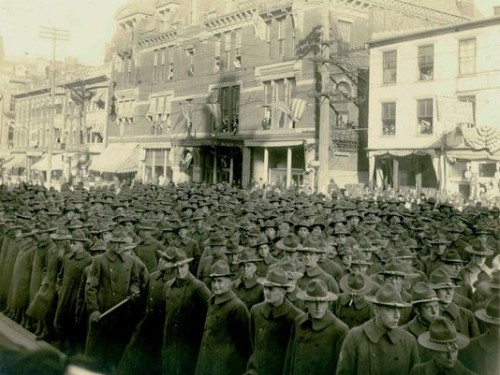
One way that the de-politicisation of Paganism in American has strongly influenced our practices is in our relationship to the military. I address this to some degree in that column, and I found myself in a very long discussion about this today with people I respect but disagree with vehemently. Generally, we don’t talk about the role of the US military in the subjugation and slaughter of peoples (both here, as in the First Nations peoples, and in foreign wars) because, well, quite a few Pagans are in the military.
Also, just like in the larger American political scene, there’s a stranglehold on criticism regarding the military because of something rather unique to American Nationalism.
Notes on National(ist) Identity
This is how nationalist identification works: Authority plays upon familial, tribal, and community bonds to create an ‘imagined community’ of which we consider ourselves a member.
Americans (unlike Germans and many others) tend to say ‘we’ when talking about the United States. Even leftists get caught up in this, making statements like ‘We bombed Nagasaki’ despite the fact that none of us actually did so. It was merely done ‘in our name,’ or later declared to be the will of the people.
This nationalist identification is what allowed George W. Bush’s statement, ‘you’re either with us or with the terrorists’ to resonate so deeply and become so difficult to argue against during the Afganistan and Iraq wars.
Perhaps the most effective counter to nationalist identification during the last decade was the anti-war movement called “Not In Our Name.” As Authority continuously played on collective identity, the only good way to counter their ploy was to proclaim, ‘no–you don’t get to kill people on behalf of me.’ In fact, it was a perfect example of anarchist theory, and it really appeared to frighten the warmongers.
But then those fucking yellow ribbons became a thing, Or, more importantly, the propaganda behind it. Those who were against the slaughter of Afghani and Iraqi people suddenly found themselves needing to prove that they supported the soldiers who were doing the killing. And those of us who had friends or family in the military suddenly found our tribal/familial bonds manipulated back into American Nationalism.
The resulting compromise (you can be anti-war but must support soldiers) is, as Annika Mongan pointed out to me today, evocative of the ‘hate the sin but love the sinner’ logic, the sort which is used by evangelical Christians to defend their disgust of gays but assure everyone that their hatred doesn’t extend to the body of the homosexual himself.
Saying
‘I’m against killing children in war, but I honor/respect/cherish the soldiers who kill them’
seems unsatisfying as a critique of US imperialism, and hardly solace to the parents of those dead children. Worse, it allow us to feel ‘moral’ twice: first by being against imperialist war, and secondly by not alienating those who get paid to fight in them. It’s a perfect strategy, if the goal is to continue American Capitalist dominance of the world while also shutting down all effective criticism of that dominance.
For a Pagan soldier in any of those wars, what precisely does a Pagan critique currently have to offer them? We currently have nothing more interesting to say than the rest of society. We like forests and dislike pollution and slaughter (generally), but really, we don’t say anything that others aren’t already saying.
What if, though, we started saying the truth? Something like:
“thanks for killing on our behalf so we can keep up our addiction to oil and not confront the impending end of Capitalism.
Sorry you were poor and didn’t have many better options.
But, hey! we got you a pentagram for your grave.”
Or would that be too political?
The Heart Of Empire
The other complication I see with American Paganism is our inability to see quite where we happen to live. The United States is the richest and most militarized country in the world. Not only that, but it is the primary ‘policeman’ of Capitalist empire, enforcing the will of bankers and multi-national corporations through trade agreements, political pressure, and direct violence throughout the world. Pagans in the United States are not just tree-hugging, crystal-using, peace-loving witches, but citizens at the heart of empire.
American Pagans might try to consume less than their neighbors and the rest of American society, but we still look like voracious hoarders and gluttons compared to the impoverished peoples in the southern hemisphere of the earth we venerate so profusely. Our decisions to drive a little less or eat only organic certainly feel nice and make us a little healthier, but they don’t stop the fact that the United States government is sending poor people into the middle east to slaughter people so there’s more oil around.
We’re not just in the heart of empire, we are colluding with–and to some degree are–that empire. Our complicity is part of the trick of nationalist identification: few of us would ever make these decisions if they were up to us. But we comply nevertheless, because we continue to enjoy the benefits of empire without trying to stop it.
How would we actually stop such a thing, though?
I donno.
But maybe it really is time we changed what we say to all those Pagans in the military.
 Rhyd Wildermuth
Leave a comment