Diminished stores, reawakening earth
It happens every so often that I burn myself out a bit, especially in winter. The telluric currents of the earth run sluggish in the colder times, the solar currents are distant. All that’s available is reserve—what you gathered before the winter, to last you through the short days and cold nights.
Sometimes I use too much of it; the hearth burns bright and hot, and then there’s nothing left to keep it going for a little while. I know this pattern, I know I do this, but I don’t yet have the wisdom to measure it all out better.
Imbolc is coming, though, and everything awakens again. Here on the continent, the same day is called some variation of Candlemass: La Chandeleur, Lostage, Lichtmis.
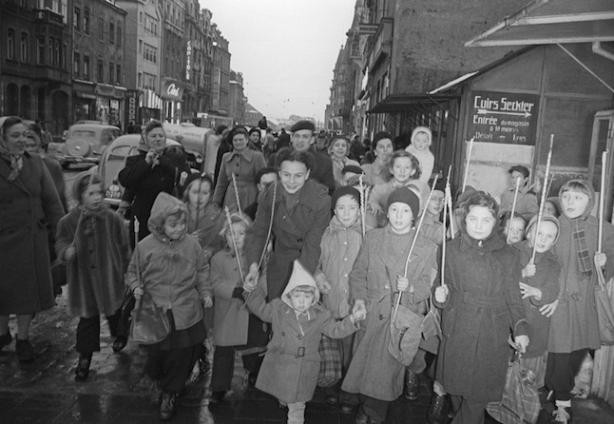
In Luxembourg, it’s called Liichtmëssdag, and it’s got a quite peculiar tradition attached to it, reminiscent of Halloween or Christmas caroling while also being a stark reminder of winter famine. Children gather in groups, holding candles, and march from house to house, banging on doors, singing a rather threatening song called Léiwer Härgottsblieschen. Part of the song is as follows:
Gitt ons Speck an Ierbessen (Give us bacon and peas)
Ee Pond, zwee Pond, (one pound, two pounds)
Dat anert Joer da gitt der gesond, (then next year you will be healthy)
Da gitt der gesond. (you will be healthy)
The song’s apparent blessing of people to whom it is sung is actually much more menacing than it seems, which the next two lines show:
Loosst déi jonk Leit liewen
Loosst déi al Leit stierwen,
“Let the children live,” the children sing. “Let the old people die.”
Before industrialization, the food reserves of most people would have dwindled by the beginning of February. The peas the children are begging for are not the fresh sort, but rather the remaining stores of dried ones from the previous year. And the bacon is not what we think of now, but rather large strips of unchewable fat and gristle. Both would represent the final stores of food for households, the very end of their reserves.
It seems a dark reality that children would be begging old people to give up on life so they could live, but that’s not actually what’s happening. The old Irish Gaelic word for that day, Imbolc, means something like “in the belly,” and likely referred to the impending birth of lambs. The milk of sheep, goats, and cows that flows after their calving would have been—for most people in northern climates—the first new food source available after the winter.
All of that was coming, and just around the corner. The shakedown of the old people for their last food stores, then, happened just at the end of the winter when more food was about to arrive. Life was beginning again, and was just around the corner.
Regardless our modern, petroleum-fueled abundance, these cycles still continue in our bodies. They do in mine, anyway. I’m always at the end of my reserves by mid-January, scraping together what is left and finding that amount to be quite paltry. It’s okay, though, because the light’s returning, and soon enough the currents of earth and sun burn bright enough to warm me back to life.
Despite being quite at the end of my own stores, it’s been a good few dark months. Though I didn’t take much time off (I should have), my husband took three weeks off and we traveled for a few days. Getting to see him so much might have been the only thing that really got me through all this work.
We drove to Switzerland, then through the Jura to a friend’s domaine in Burgundy, with one day spent walking about Lyon. Lyon is everything Paris is, but without the Parisians, so it’s quite fantastic. Here are a few pictures from our trip:
The top three photos are from my friend’s domaine, one of the most peaceful places on earth. He’s also a druid, and the final photo in the series is of the Roman fountain next to his place.
Since my reserves are so low, and because I’ve noticed that looking at screens is a really fast way to deplete what’s left, I’ve been trying to do most of my reading on paper again. Also, this is the first time in the last ten years I’ve felt confident enough to collect print books again. When I left the US for Europe, I had to leave about 300 books on that continent (I gave them to an former lover), and since then it’s taken me a long time to let myself accumulate them again.
For books, I’m currently reading China Mieville’s riveting account of the Russian Revolution, October, which I’ll write about soon. Then, it’s next on to Bourdieu, more Agamben, or a Baudrillard book I’ve not read yet. After all that, I plan to read more history, as I know too little about the Frankish migrations through the Ardennes and their Christianization.
Though I’m limiting my online reading for now, I’ve made an exception specifically for Caroline Ross’s substack, which is always delightful. Consider this my full-hearted recommendation.
As I mentioned previously, I’ve more writing coming soon. I’ll be recording or being recorded on quite a few podcasts over the next two weeks. I’ll be talking about the occult cosmology of Philip Pullmans’ His Dark Materials series with the gents at TheSoapbox, and will talk with Dougald Hine about his book on The Re/al/ign. Also, next week I’ll be a guest on the Sacred Sons podcast, talking about pagan and elemental frameworks for masculinity. And there’s more coming soon.
Also, the official announcement for Here Be Monsters should be coming soon. I sent back a hopefully final round of edits on the manuscript a few days ago, and I’m very happy with its form now.
Everything awakens soon. I hope you are all well.
—Rhyd
 Rhyd Wildermuth
Leave a comment