“Call this dreaming, though remember: dream has power.”
This is an essay in my series, The Mysteria. Research for this essay series — as well as for my next manuscript — is being provided by my many generous founding supporters, including Stephan Wrede, Annika Mongan, Harrison Preusse, Rebecca White, and 17 others.
You can become a founding subscriber by upgrading your current subscription below. Information on how to contribute directly is at the end of this essay.
The previous strategy of “thou shalt not have unauthorised dreams” has been superseded by a more terrible strategy. It is not simply dream that has been derided as meaningless, but every aspect of our lives.
… We are pitted against an industrial industry which fabricates our dreams for us and insinuates them through our culture and our language. How can we dream when our vocabulary of symbols has only the nuance of newspeak?
Peter Grey, Apocalyptic Witchcraft
“But I Was Just Sitting On This Lettuce…”
My writing has been quite sparse here since for several weeks, as you’ve no doubt noticed. Four weeks ago, I announced I intended to begin a new book. Some very kind readers offered me a significant sum of money to fund my initial research, and I started reading immediately.
I didn’t know what I was getting myself into, and I still don’t. Things…happened. Things are still happening. Things will keep happening. And I don’t know how to make sense of any of it yet.
After receiving those gifts, I immediately began reading, purchasing some shockingly expensive books. Academic knowledge is often locked away behind extraordinarily high prices to keep the rest of us out. Sometimes, rogues help the knowledge escape digitally on clandestine pdf sites. Sometimes, it’s the authors themselves who abscond with their own writing, secreting it out from the ivory towers since, anyway, the publisher’s not paying them shit.
That underground of distribution is hardly a new thing, preceding the internet by hundreds if not thousands of years. Much of the magical knowledge we have in “the west” was copied and preserved by monastics, the “literate” medieval class. Before the printing presses, the scriptoria in the monasteries and abbeys were really the only places you could find paper and ink and people who knew how to read and copy the old texts.
What was a little more paper filled, a little more ink used, to copy something a little less canonical?
It’s from them, what’s been called by historians the “clerical underground,” that most of what we know about magic in medieval Europe survived. Men and boys, huddled over wooden tables in candlelight, copying scriptures and spells, rites to exorcise demons and rites to summon them. Priests, some bishops, and even a scattering of archbishops read and then copied these works, and added to them, so others could read what else was possible between humans and the unseen.
I started my research with witches, then found myself with werewolves, and am now chasing down preserved magical practices in Frankish lands. There are demons everywhere, including ones sitting on lettuces, waiting for nuns to eat them because they forgot to make the sign of the cross. According to Gregory of Tours (“Gregory the Great,”) a nun once ate such a lettuce without first signing herself. Because of that, she actually also ate a demon, which later, when exorcised, said, “but what did I do wrong? I was just sitting innocently on the lettuce, and the nun ate me.”
The “sign of the cross” is likely much older than Christianity, by the way. It appears to work for demons on lettuces, and for other demons, the good and the bad. There are other signs that work for other things, but the Christians didn’t — maybe couldn’t — work those into their magical system.
And that’s the thing. The more you read these old works, the more you realize that Christianity is a magical system. No, of course it’s also a religion, but it’s only Christian exceptionalism, the narrating of Christianity as a “true” religion and all others as “false,” that allows anyone to pretend it wasn’t also a magical order.
We can start with the obvious here, the Eucharist. Sacred mystery feasts were of course hardly invented by the Christians, but were rather a common feature of pagan mystery cults. The transubstantiation is incidentally a later medieval idea, one which arose in response to a Christian need to redefine what sort of magic was allowed as miraculous and what sort of magic was forbidden as sorcery.
It’s not that the earlier conception of the bread and wine was merely symbolic (as the Protestants would have it), but rather that earlier Christians still held onto the pagan idea of mysteries and multiple existences. Just as a forest could be a group of trees and also the body of a goddess, the bread and wine could be what they were and also the body and blood of a god. There was no initial need to “explain” how it happened, it just was.
The doctrine of transubstantiation was needed later as early materialist thinking began to redefine Christian cosmology. Because a forest could no longer also be a goddess, bread could no longer also be body without some new explanation. Transubstantiation was the solution for this, but it had the laughable consequence of turning holy wafers into a magical commodity.
The trick for the Christians was that they called all their own magic “miracles.” It was a miracle when a saint flew through the air or banished a spirit, and malefica when it was someone else doing those things. Brand it with “Jesus” or “the Queen of Heaven” or “The Holy Spirit” and you could speak with the dead, transfer demons and diseases to passers-by, call lightning down from the heavens, divine with severed heads, and travel to wondrous lands and meet long-dead people just like the sorcerers did, and then pretend you weren’t doing sorcery at all.
All this magic was older than them, and merely re-labeled, just as many of the religious rituals were older and merely transferred to the new order. The easiest way to see this is to think of all the orthodox icons of Mary venerated by hermits and monks in caves to this day. Before the new order, the devoted venerated nymphs in those caves. The names changes, and so did the magical order, but the veneration continued otherwise unchanged.
Likewise, Pagans venerated the bones of their ancestors in shrines. Christians outlawed this, burned down the shrines, slaughtered the pagans, and then filled the cathedrals and chapels they built over those shrines with the bones of ancestors they called saints. The order changed, but the magical and religious rituals which upheld it didn’t.
The Christian order accumulated unto itself all the magic it could use to increase itself and its power, while punishing with death any who threatened their monopoly.
Dreams in the House of Wheeling Flames
Since I began reading for this book, I’ve suddenly found myself haunted by early childhood memories I could never make much sense of. When I’d think of them before, I’d shake them off as soon as I could, because some of them were really quite terrifying. They still are, but I’m slowly finding myself at least able to look at them for a little longer.
All these memories are from my time in Appalachia, where I was born. I lived there for the first two years of my life, and then again from six or seven until I was 12. I remember almost nothing of those first two years, but the strange things which happened to me in that later part are seared deeply into my memory.
I’ve written of one of these memories already, the “man from the stars.” That one is a memory still unfolding, and never one of terror. Others, on the other hand, still make me shudder.
I met something when I was seven or eight, and I’d very much like never to do so again. I remember the feeling of utter horror, muscles frozen in bed. I don’t know if my eyes were open or closed, but regardless they were staring at what seemed a spinning chandelier of tiny bicycles, ridden by flaming candles, all upon a field of unearthly white.
I struggle with a metaphor for the feeling I had. The closest I can come up with is the sense you get when you’re staring at your reflection in a shop window and then suddenly realize the people inside think you’re looking at them. You were looking directly at them but didn’t realize they were looking back. Once you see them seeing you, you feel a chill, shudder for an instant and then quickly look away.
Now, imagine you couldn’t look away. Instead, their gaze, initially invisible to you, now held you paralyzed, and in that moment you suddenly feel as if it was you inside the shop window. The entire world turned not upside-down, but inside-out.
Worst of the experience, though, was the silence. What regarded me was a devouring silence, a cannibal silence glutting itself on all other silences. It was a still-born scream engorged and gorging upon all other stillnesses. It was a silence that felt like sound, a chittering void, a cacophonous vacuum.
That wasn’t the only such experience, but it was by far the most terrifying. Very frequently, I’d wake up with my face pressed up against the ceiling. Except I was also still in bed, eight feet below the ceiling. The first time this happened, I screamed, which put me back in my body below. On subsequent nights, I figured out I could just tell myself to go back to my bed and my body, and I would be there again. This happened for weeks until I finally learned how to stop this, and it never happened again.
My Uncle Was a Jumper, My Mamaw was a Witch
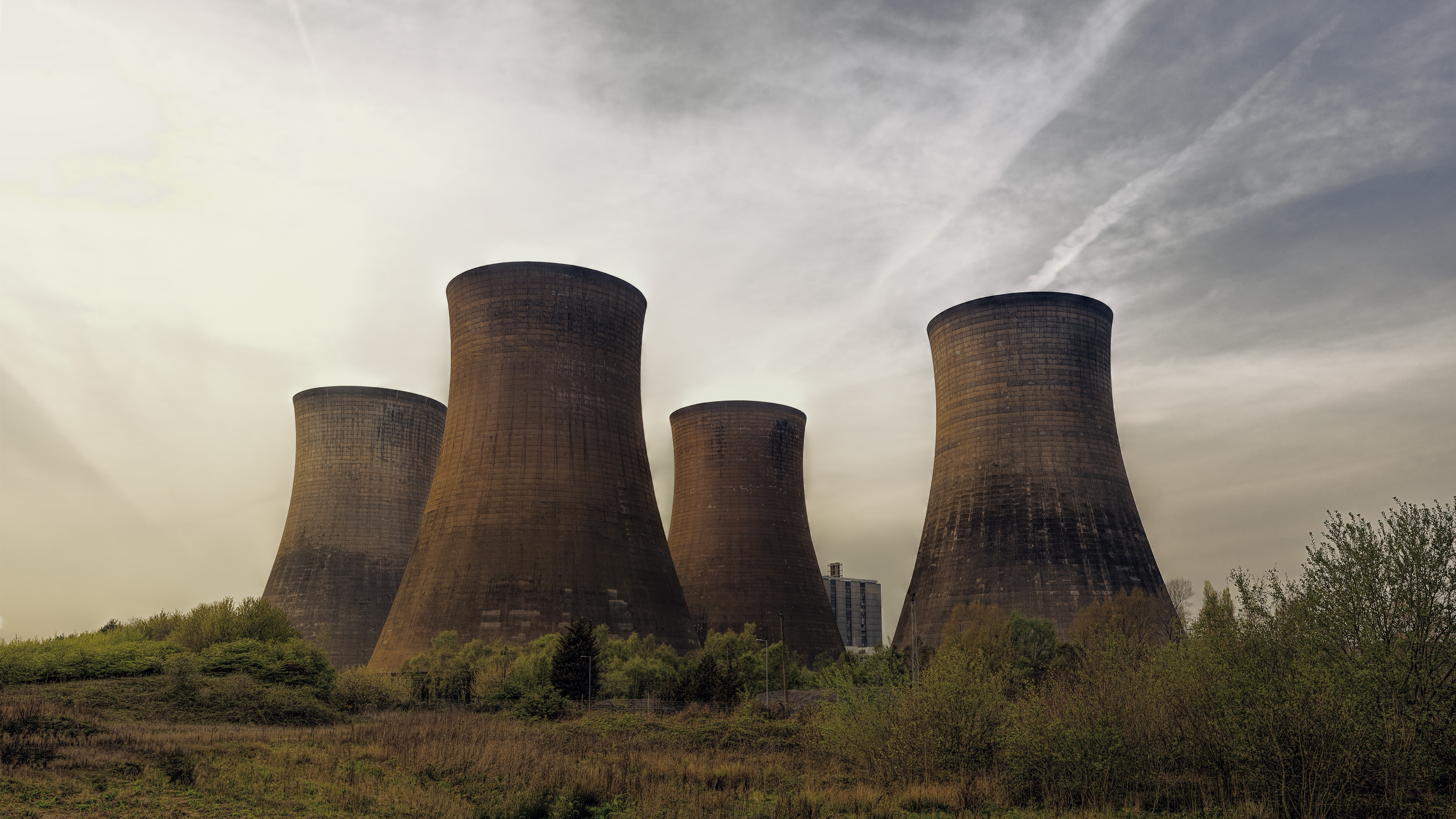
Here in the present, in Luxembourg, I live about 30 miles from a nuclear power plant, for the second time in my life. In the house where I saw the wheeling flames, I also lived about 30 miles from a nuclear power plant. That one was decommissioned sometime after I was born, supposedly because it was no longer “needed,” and not at all because it was also leaking.
Babies there were often born covered with strange red growths — “strawberries” they called them — all over their bodies. My cousin’s child was covered with them, and it took multiple surgeries to remove them. Lots of people got cancers, and died of them, including both my papaw and my uncle.
My father buried my uncle, his twin brother, after a year of caring for him as the cancer made him crazy. By the end, he had been shitting all over himself, barely able to eat, constantly screaming, constantly lunging at my dad with his fists. My uncle was far too large a man to carry to a tub for a bath, and he wouldn’t stand up long enough for a shower. On warm days, my father would spray his twin brother down with a hose outside to clean him. No one had enough money to put him in a home or in a hospice, or to pay someone else to care for him. My dad set him up in the basement, caring for him like you might a wild, rabid animal.
My dad, ever the denialist, insisted for years that his brother’s cancer had nothing to do with the nuclear power plant, despite my uncle’s employment there as a “jumper.” Regulations say you can’t be exposed to more than a certain amount of radiation per year, equivalent to 250 chest x-rays. But the regulations don’t say anything about how much you can get per day, and so there are the jumpers. Men, trained briefly and then hired for one day, or rather for just a couple of minutes, “jumping” into the reactor room to perform a quick job, getting their years’ allowance of radiation all at once.
They say my uncle was obsessed with demons. He saw them everywhere, more and more as the tumor grew in his head. He had all the internal doors removed in his house so he could be sure nothing demonic was happening behind them. Sitting in her driveway with his wife and kids, he’d pray cleansing and protection prayers just before and just after visiting his mother, my mamaw, because of the hold the demons and Satan had over her.
In fact, though, my mamaw was a bit of a witch, and I reckon she wasn’t strange to demons. She kept a box of index cards scrawled with recipes and folk remedies. How to heal a bee sting, how to preserve fruit, how to get rid of stains, how to stop a fever, a cough, a diarrhea, to win at lotto, to find hidden things, to tell if someone is lying. Some of them, I’m sure, were from Betty Crocker and Reader’s Digest, but I ain’t so sure about the others.
Medieval magic manuals weren’t all that different from what she did. I was just reading about one such, the 15th-century Wolfsthurn handbook. Probably compiled by the lady of a castle or one her servants, it was full of practical remedies, recipes, and prayers to deal with rats in the cellar, to get better at fishing, to make homemade soap, to reduce fevers and alleviate menstrual pain, and of course to make demons go away.
Mamaw was a bit of a witch, yes. She sacrificed a cat the night I was born. Or, rather, she killed it so that I would live, which is anyway the same thing. Took it out of the trailer while my mom was in labor, while I struggled out of her womb. Shot it with a rifle.
“They suck the breath out of baby boys,” is what she said.

Inoculating Against Dreams
I see the wildest things before I go to sleep, hear the most eerie sounds. Sometimes, it’s fragments of conversations between people I’ll never meet. Other times, faces surprised to be seen. Occasionally, something dances and then hides just after giving me some word I’m left to try to understand.
Sometimes, things come to me in explosions of colors that cannot exist. Especially in wilder places, the moments before sleep are full of them. I remember the green that was also gold, rose, and copper, each and none at all, not mixed but the source of each. It’s a color that cannot exist, and yet I saw it first in a dream and then saw I’ve seen it countless other times. It’s the color of evening sunlight at a certain slant illuminating the trunk and branches of a summer oak. No machine can reproduce this color, only its sense, and only then by putting the colors close together. Mix them as with paint, and you get a very ugly brown.
The colors aren’t terrifying, but they unsettle. They have a pregnant silence to them, just about to speak wordlessly of something no human can bear to hear. Unlike the wheeling flames, the colors, or whatever’s behind them, are quite welcome. I watch them dance before sleep and wonder why they’re there. I suspect they are watching me back, especially when I dream, and that’s fine.
I think often about how terrifying it can be to dream sometimes. Not just the nightmares, which are of course also terrifying, but the naked sorts of dreams, the ones without symbols. We clothe what we see in sleep in familiar garb to make it less alien, dressing it all up in preferred faces and backdrops to give it all more comfortable form.
And sometimes, we are stuffed full of others’ dreams so that we cannot dream our own.
My mamaw’s been in my dreams lately. She’s never been in them before, but now she’s here, and I think she’s teaching me to fly. I didn’t understand her before now. She was so strange, sometimes so feral, that I didn’t feel as if she was even family at all. Her dead son thought she talked to demons, her still-living son — my father — stopped talking to her years before she died. I’d not seen her for a decade before her death, but now I’m seeing her again.
Her third husband, my papaw, died from a brain tumor, too. He wasn’t a jumper, but an electrician, working contract work at the plant, long before the cancer became obvious. The tumor made him crazy too, but he died much faster than my uncle.
Mamaw got a lot of money from his death, and also from her son’s death, payouts from the power authority that ran the plant in return for saying nothing at all about why they died. She even sent me some of it, a thousand dollars 15 years ago. I learned of it standing at a payphone in Lyon, backpacking across France and Germany with a partner. He was broke and so was I, and we had two more months before our non-exchangeable plane tickets were due to take us home and no money to live on until then.
So, money from a nuclear power plant that killed two men in my family at least got me a couple more months in Europe, which is how I fell in love with this continent, and is one of the reasons why I’m living 30 miles from a nuclear power plant again.
She’s one of the reasons I’m here.
This nuclear power plant is in France, situated right up against Luxembourg’s border. Sparsely populated on their side, densely populated on ours. Fallout would harm us much more than it would harm the French, which is of course why the French put it there.
Everyone in Luxembourg gets “KI” pills, just in case. Potassium iodide, for the thyroid. In the first few days after a leak, you take these pills to fill up your thyroid so it’s full. No room for more iodide, radioactive or otherwise. Any good magician knows and any good artist knows, that’s also how you can stop dreaming. You fill yourself up with others’ dreams until nothing else can get in.
I’ve thought of this often since I started research for this book. I’ve thought of all the times I’ve filled my soul and my mind with other people’s thoughts and other people’s visions so I cannot think my own thoughts or see what is in front of me. I’m hardly alone: this is the default state of modern technological life. If it’s not television or films, it’s social media, video games, or whatever else we can shovel inside ourselves.
We’ve all been doing this so long we’ve forgotten we were doing it. Like filling up on junk food before dinner or taking iodide pills after an “incident,” we make sure there’s not much room for anything else, anything that might actually change us, to get in.
Silvia Federici noticed that the transition to capitalism involved a war against magic and magical conceptions of the self and the world around us. This included also a change in the way we thought of the imagination and the imaginal realm. One of the core arguments of Peter Grey’s Apocalyptic Witchcraft is that this war against the older order took place also on the field of dreaming, especially in the obsessive hunt against those who claimed to engage in night journeys, the “witch’s flight.”
On such flights, people claimed to meet with others, with the dead, with spirits, with devils. There, in dream, spectacular and familiar figures, distant and wondrous landscapes, and acts of great power danced before them, and they danced in and with them.
In the witch’s flight, we see what else is possible and what else is there. Call this “imagination” if you must, though it’s more truly the imaginal. Call this dreaming, though remember: dream has power. Dream is so powerful that priests and judges hunted down those who dreamed of flying, those who claimed to meet others at night while the Christian world slept, those who met with spirits, with demons, with the dead, and learned from them new ways of living.
And so now I’m learning to fly like I did when I was a child, no longer scared of waking up with my face pressed against the ceiling or seeing the wheeling flames. It’s a lot easier when you’ve someone to guide you when you sleep, someone who will meet you there just past the threshold. I’m suprised to finally see her, but also glad of it, but I’m still not really certain about that thing with the cat.
If you’d like to support my research for these essays and for my manuscript, you can either do so by becoming a founding subscriber to From The Forests of Arduinna or making a direct donation.
And if you’d like some great advice on remembering your dreams, try this.
 Rhyd Wildermuth
Leave a comment