I’ve said this before: I’m kinda slow on some stuff. A god can make something repeatedly obvious and yet I miss the message; like Eliot’s “had the experience/but missed the meaning,” the point of something will slip past me until much later.
In this case, years later. It was one of the first things I was shown, one of the things that’s been shown to be repeatedly, and yet…
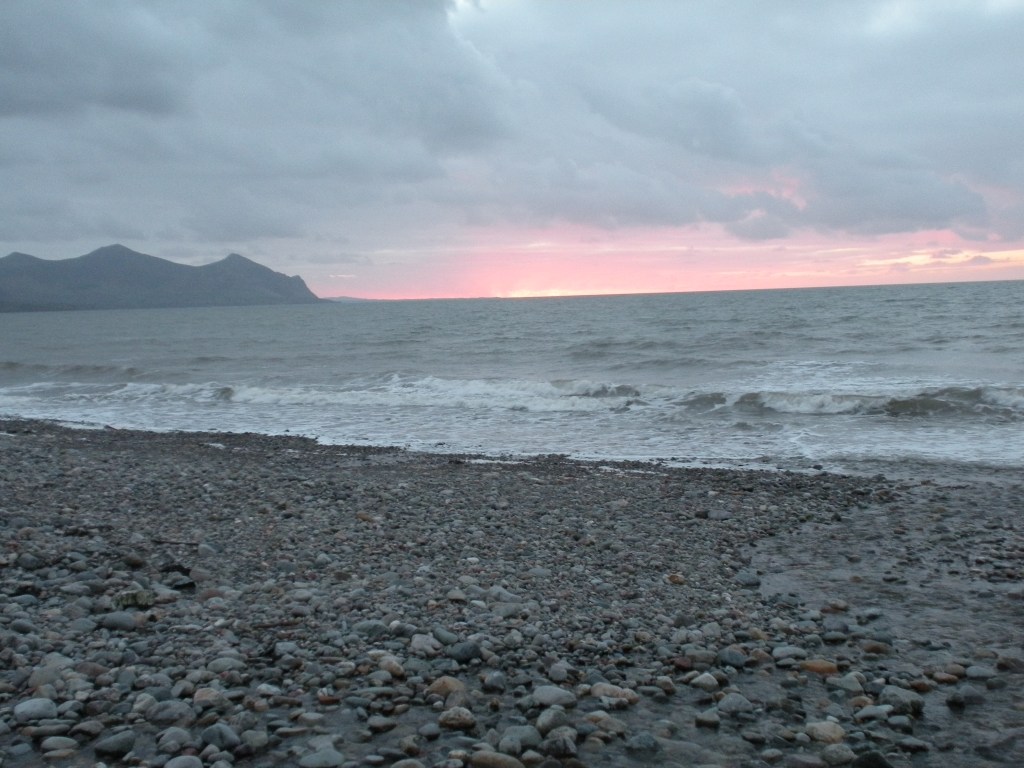
When I stood on the beach just south of Dinas Dinlle, on the shore across from the sunken reef known as Caer Arianrhod, a mass of symbols danced before me, each incomprehensible. I felt the idiot, unable to weave those symbols into meaning. Something stood out of grasp, too far for me to reach but not so far that I could gaze upon its whole being.
Since I’ve been back from Wales and Ireland, Brân’s been heavy at my neck. I’ll be writing much more on this for a piece I’ll submit for the “Building Regional Cultus” of Walking the Worlds, but a few things are worth noting now. On the shores of Llyn Dinas I encountered beings, giants and something else I’m reluctant to name yet, all deep spirits of the land there, all much bigger than I, each, again, speaking in incomprehensible symbols.
And since Pantheacon and the announcing of Gods & Radicals, Arianrhod’s been all over, seemingly waiting for my mind to break open enough to allow some greater knowledge room in my thick skull. It’s seemed odd, surprising, but I think I’m finally starting to get it.
Arianrhod’s in the dance of sea and symbol. I don’t know how to explain this yet–it may take quite some time. But since I learned to do something I hadn’t learned to do yet, layers of symbols dance upon themselves in a knotted threading, each existing in-itself, not derived from but reliant upon each other symbol.
Not a hierarchy of symbols, but a tapestry of them. There is Ivy; the sight of Ivy, the embodiment of Ivy, the space and presence and spirit each of Ivy. There is also Ivy as thought, Ivy as meaning, Ivy as the seed of Ivy that we know (similar to Platonic Ivy but also different). “Ivy” as sound is mere approximation, but also the human inception of Ivy into the world of humans (that is, the ‘Worlding’ of Ivy).
Still following?
We tend to make a distinction between “Ivy” as our name for the thing (or material existence) of a specific type of plant and our experience of it, as if the word/sound/symbol of “Ivy” is distinct from the thing. Older forms of knowing, however, suggested that the plant itself generated or gifted the sound by which it was to be known.
Consider the linguistic differences inherent in English’s question ‘What’s your name?” versus the French “Comment t’appelle tu?” (How do you call yourself?) and you’ll get an idea of this rift. Does a thing have a concrete name, is it named, or does it name itself?
Perhaps all three are true, and this is where Arianrhod is, or dwells, in the dance between those symbolic representations and the ‘real’ of a thing. And in Modern, materialist thought, we separate dualistically the ‘thing’ of Ivy from the ‘experience’ and ‘representation’ of Ivy. This, I am suspecting, is the source of Disenchantment, as applicable to our understanding of gods and trees as it is to the land and Animistic understandings of nature. Also, I think, why Arianrhod seems to have ‘withdrawn’ from the world into the sea like an ebbing tide (and, remember–ebbing prefigures another movement…)
The material of Ivy, the touch and feel and molecular structure of the plant we know as Ivy, therefore, exists interdependently with all the experiences and representations of Ivy. The plant doesn’t come first, doesn’t sit at the bottom or the top of a hierarchy–it is itself-and-also, becoming more-than-self in the way that we become more-than-self in love. Ivy and the word ‘Ivy’ dwell in each other, which is how we can know what a Hydra is without a material existence or a god is without a physical body. It is also how a nameless thing does not exist to us, seems to be ‘soul-less’ despite physically blocking us (like a wall in the dark) or killing us (like an unidentified disease).
Which, too, is why the first thing Arianrhod takes from Lleu, and the first thing she takes from any initiate, is also the very first thing she gives–a name.
Also
Gods & Radicals is coming oh-so-soon! We’ve got some damn awesome folks lined up for the site, and I’m stupidly excited.
The site’s set to private as it’s being built and everyone’s getting used to the layout. In the meantime, you can follow Gods & Radicals on Facebook or Twitter or both.
More soon!
And be damn amazingly well.
 Rhyd Wildermuth
Leave a reply to Lee Cancel reply