A brief travel journal from my trip to London
I woke early Saturday morning and traveled, groggily, from the tiny Ardennish village in which I live to London for the second in-person event for my book, Here Be Monsters.

I love traveling, and always have. Something happens in the moments where you are in-between, en route, no longer where you normally are but not yet where you are going. The thoughts you think change, and new thoughts come, sometimes sweeping across and through your mind like winds.
Years ago, there were several “viral” articles about how traveling is “classist,” a “sign of privilege,” and even “white supremacist.” As with similar other articles, this kind of drivel was written primarily to give people who’d not yet traveled something to assure them they’re not missing anything, that they are someone more moral for not going anywhere than those that do.
Such screeds generally relied on the commercialized representations of what travel is, and I felt quite sorry for those who assumed such things were true. We generally cannot help mistaking the simulation for the real, especially if we’ve never actually experienced the originals that such images poorly copy.
When I was younger, I got quite good at traveling very cheaply. Some twenty three years ago, I journeyed over 3,200 miles (5,000 kilometers) for about $55. Seventeen years ago, I flew from Seattle to Europe, traveled to several cities there and camped for three months, and then came back, for a total transportation cost of about $700.
Explaining for others how to travel like this, I’d usually tell them that the key was being creative and flexible. Especially for flying, a seemingly counterintuitive and convoluted route is often much cheaper than anything direct. One time, for instance, I was able to get a $100 flight back from Berlin to Seattle by spending half of a day in a rarely-used airport in Norway for a connection. Another time, I traveled by bus from the westernmost edge of France to the easternmost edge of Germany for 25 euros.
What I never admitted to myself until recently, however, is that this kind of travel requires excessive amounts of time, even more patience, and sometimes a complete lack of self-respect. That bus between France and Germany took 16 hours, for example, and the cross-country US trip took three days. I’ve slept overnight on the floors of quite a few airports and train stations just to travel cheaply, and it was only in late 30’s that I started asking myself if what I was trading away was really worth the money I’d saved.
Still, though, I’m glad I learned to travel that way. Increasingly, I’ve the sense that the past few decades of relatively easy border crossings may soon come to an end, and as Silvia Federici noted, “fixation” of the working class “in time and space” has always been a primary obsession for the capitalists and the state. Add to their perpetual worry that we might mix too much with each other the likelihood that the wars in both Ukraine and Palestine will probably soon spill out, and you’ll see why I worry that travel will soon become a thing only of nostalgia for people like me. `
Again, though, I’m glad of what I learned, as I needed those skills again for this trip. It was a holiday weekend (All Saints) in Europe, and all those increased travelers had inflated the prices of even the “budget” airlines. While my publisher had agreed to again offset some of my costs, it wasn’t enough to pay for any accommodation in London, nor for any direct return flight to Luxembourg.
I left very early in the morning from Luxembourg to Stansted airport, one of the two airports outside of London proper which primarily accommodate Ryanair, Easyjet, and many of the other low-cost and no-frill airlines. I was able to find a cheap flight with Ryanair (though, of course, the final fee you pay is rarely the original fee they cite). From that airport, there’s an express train route to several major stations (£ 22, or £ 35 if a round-trip), or, if you have enough time, some significantly slower bus routes (£ 12). Taking all that into account, though, it was easily within my travel allowance to get from Luxembourg in the morning to the event in London.
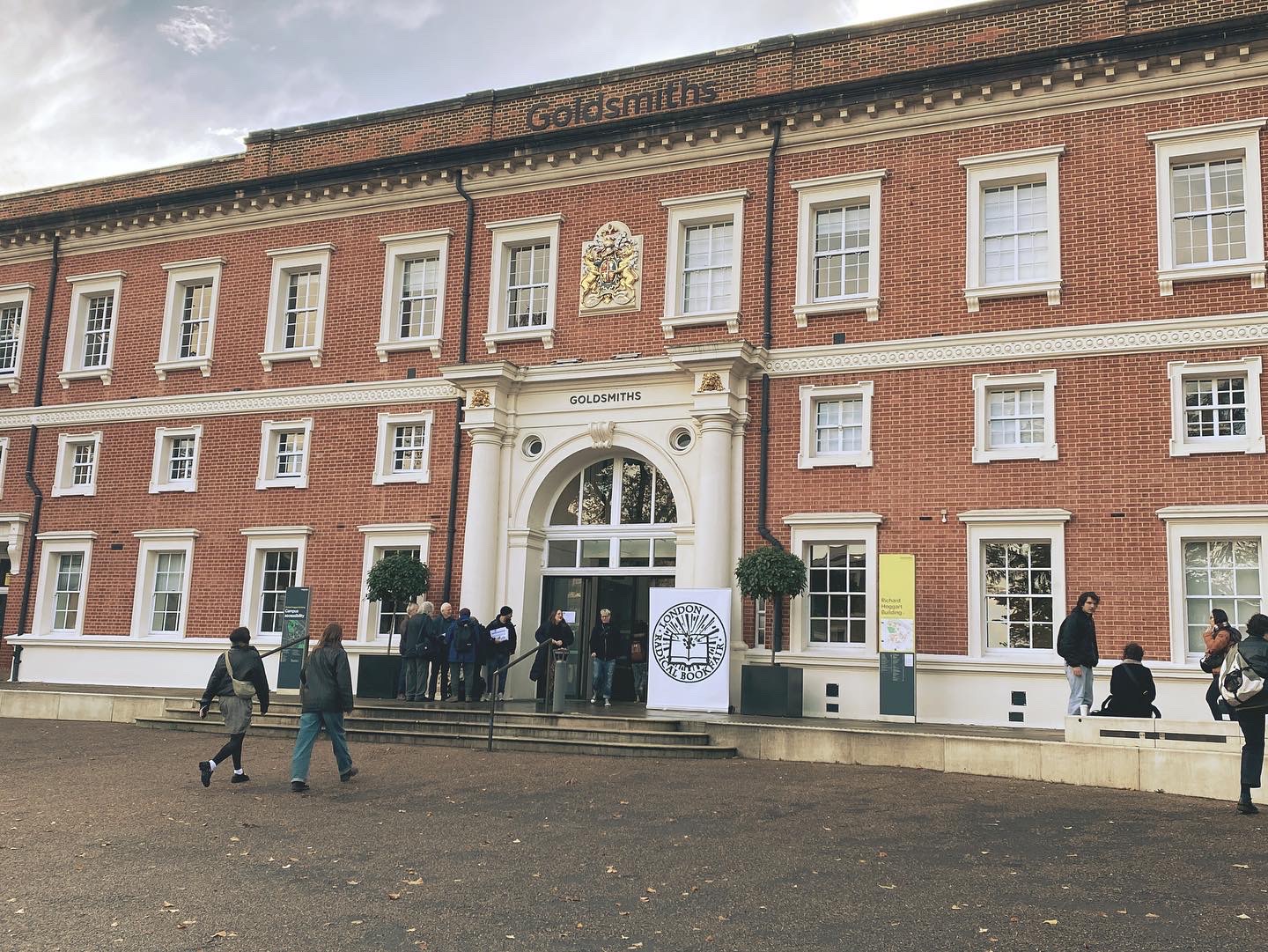
I’d really not known what to expect before arriving, and I’d been a bit nervous. It was the first year the event was occurring since the Covid confinements, and I’d seen remarkably little mention of it on social media until just two days before the book fair. I worried a bit that it wouldn’t be well-attended. Also, I’ll be honest — there was a bit of a concern about how other leftists might receive my book.
I had no reason to worry on either account.
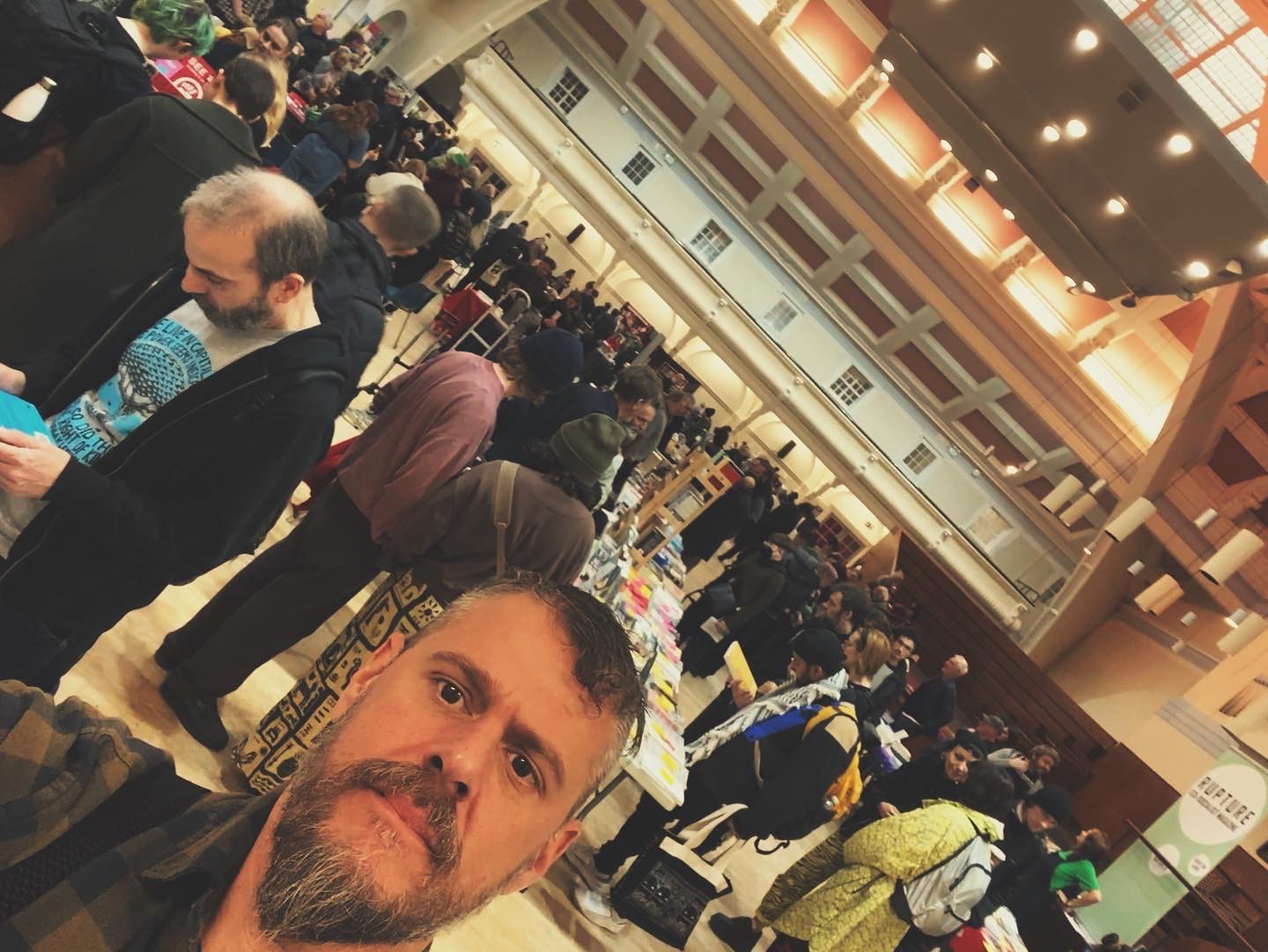
That’s a picture of the large hall where publishers and bookstores had their tables, taken from the Repeater/Zer0 books stand about a half hour before I was to speak. I sat and talked with the publicist, Ben, who told me my book had already been the most popular of their offerings, which gave me enough confidence not to be so damn nervous.
Again, though, I didn’t need to be nervous at all:
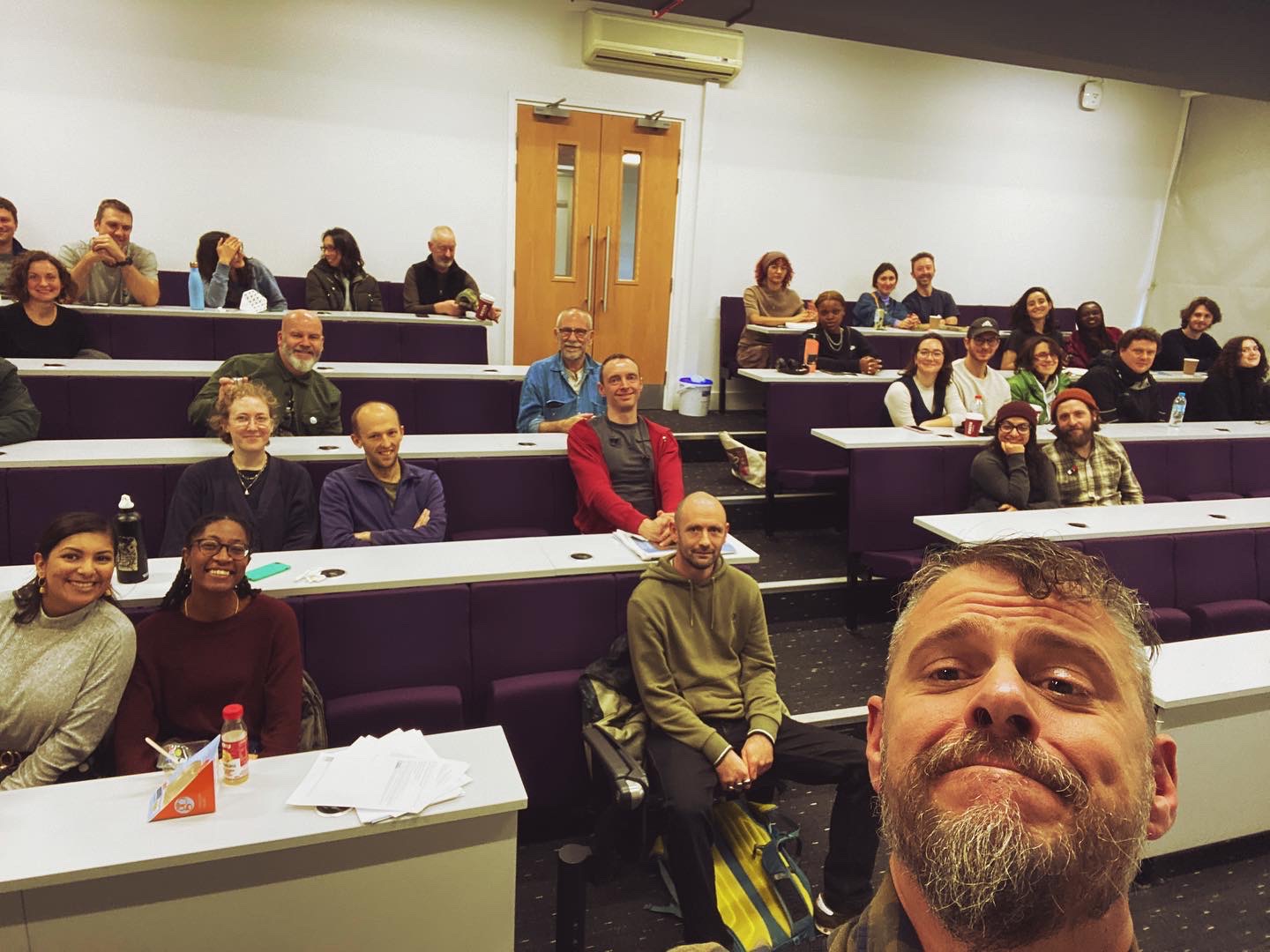
That’s the small lecture hall where I gave my talk, taken a few minutes after it ended and with the permission of everyone still in the room. Altogether there were about forty people, or about a third of the population of this village I live in, and it really felt as intimate as a village.
The talk was on the Radical Imagination, its power and also its perils. I started by discussing the anti-globalization protests at the turn of the millennium, and how the subsequent crackdown on populist revolt since then can only be seen as the capitalists reacting to how powerful we’d been. We’d scared them, and rightly so, but it’s been decades since we’ve remembered what was almost possible.
I think I learned as much as the audience did, because I didn’t let them stay an audience. It felt wrong to just be talking at them, as if I were some authority and they were merely students. I think I started asking them if they had questions about 15 minutes in, and the event became much more like a facilitated group discussion than a lecture, just as it should be.
I got to meet quite a few of them afterwards, and they were all fascinating and very excited about the talk. Quite often, I get rather pessimistic about “the left,” but it was impossible to feel that way afterwards. I became even more optimistic when I returned back to the book table, and Ben told me he’d already sold out of my book.
I whiled away a little time afterwards drinking coffee with someone who’d came from the southwest to hear me, and then started my convoluted return journey home. There had been no return train (Eurostar) or plane tickets to Luxembourg for that day or the next one under £ 250. I couldn’t afford a hotel in London, and taking a 16 hour overnight bus (including a four hour layover at 3am in Antwerp) after that event would have been the vilest sort of self-punishment.
As I said, though, often times very counter-intuitive routes work really well, assuming you’re flexible. And so that’s how this happened:

That’s me, standing in front of the Cathedral of Cologne the next morning. Turned out that, though I couldn’t get back to Luxembourg, there was an affordable flight to Cologne (Köln in German) arriving at 1am. Though there were no trains back from there so late, there was a hotel a ten minute walk from the airport desperately trying to fill their rooms.
I don’t even remember checking into the hotel, as I was quite tired by then. I slept the sleep of the dead, and woke up eight hours later, still exhausted, but quite happy.

Cologne’s a fascinating city, known for its raucous Carnival and its particular perfume, “eau de Cologne.” In English, we usually call scents that women use “perfume” and what men use “cologne,” but in French, all scents are parfum, and cologne is only used in reference to the once-popular perfume that came from that city.
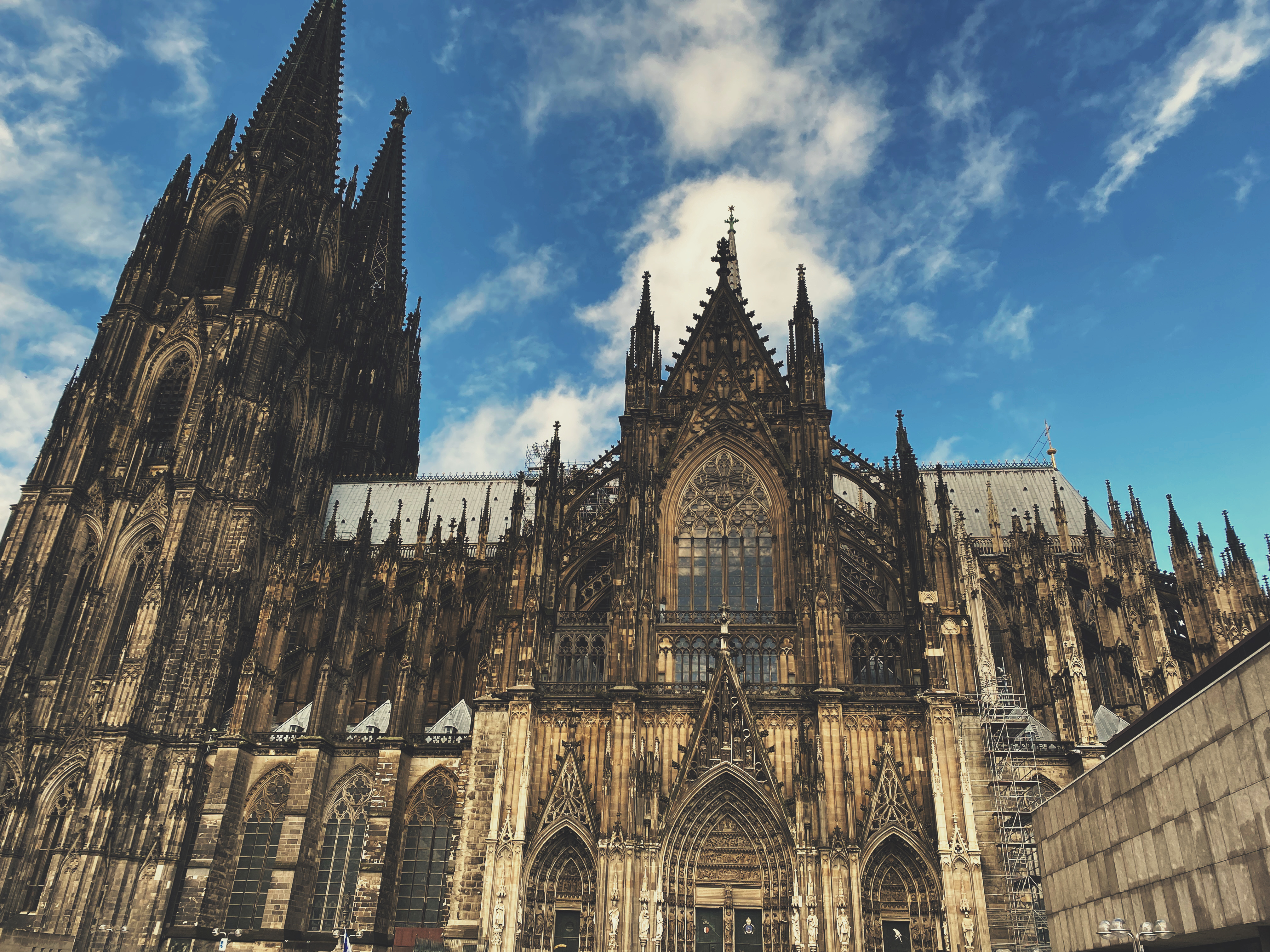
Cologne is also known for its massive and well-preserved cathedral which, despite the ruinous Allied bombings of the city that destroyed most of old city, miraculously survived. The Köln Hauptbahnhof is just next to it, meaning that the cathedral is the first thing you see of the city just as you exit the station.
This was my first time in Cologne by myself, and since I had several hours before my train to Luxembourg, I wandered the streets in a dreamlike state. Arriving to the cathedral first like that shapes everything you see afterward. Since so much of the city was destroyed during the war, many of the other buildings, in contrast with the cathedral, look not just uninspired and overly modern, but also really quite slipshod.
Initially, I thought perhaps that contrast was the reason why I kept finding myself wandering into other churches on my walk, as if seeking a return to that initial moment of awe outside the station. And then, I thought maybe I just needed to see old stuff. It wasn’t until later, standing in a strange churchyard planted with a circle of trees, that I realized I was making an unconscious pilgrimage to sacred sites, following spirits drawing me to them.
After visiting those places, I had lunch at an Indian restaurant, and then followed them back to the cathedral to see a gathering I apparently also needed to see:

That’s a photo of a pro-Israel rally, taken from as far back as I felt comfortable photographing. You possibly already know this: pro-Palestinian protests are illegal in Germany, though they’ve been happening still in a few places. On the other hand, support for Israel is enthusiastically encouraged by the government, and the Vice Chancellor of Germany recently gave a speech essentially painting any real criticism (any more than just “asking questions”) of Israel’s righteousness as antisemitism.
I stood and watched for awhile, keeping my distance in case the police questioned me, and I didn’t take any up close photos. Most of the crowd was quite old, and most people carried flags instead of signs. The signs I did see, however, surprised me, especially those referencing “Palestinian lies” and “Pallywood.”
I had to look up this word while there, and I was quite surprised. Pallywood is basically the pro-Israel equivalent of the “crisis actor” conspiracy theory that started in the United States. The idea is that Palestinians are staging their injuries, bombing their own buildings, and faking their own deaths in order to make Israel look bad. Even official Israeli government social media accounts have claimed this to be the case, and despite plenty of evidence to the contrary, some people in the crowd in front of the cathedral also believe this.
I didn’t confront anyone, and I kept a respectful distance. The last thing I wanted was to be arrested for looking suspicious. Also, as I had just come from a leftist event in London and have written things critical of Israel, I suspected any interaction with the police would go poorly for me.
Still, I think I needed to see this to ground all my thoughts on the matter, and to see how strange the world can really be. I’d just been at an event where Palestinian flags were everywhere, and then I was at one where it was all Israeli flags. As I left the protest, I passed two German trans women wearing Israeli flags as capes, while the day before I had seen two English trans women holding a Palestinian flag between them. The lines people assume are clearly drawn are not lines at all.

I thought about all this on the long train ride. From Cologne, the train slowly follows the Rhine back to where it meets the Moselle, and I thought often about how I was always alongside water from the stream across my house. At Koblenz, I switched to one heading to Trier and then to the border town of Wasserbillig, where the Moselle meets the Sûre. My husband was waiting there for me, and he drove me back to our village, and then to our home in which waited one of my favorite meals of his.
And now I’m back home for a little while, surrounded again by trees, and spirits I know, and with a strange clarity I’d never have had without this trip.
Not yet a paid subscriber? you can become one now for 20% off:
 Rhyd Wildermuth
Leave a reply to Helen Cancel reply